The Consequences of Spiritual Misalignment
Misalignment is not a “small thing” in the end-time. When a believer, a leader, or an entire church drift from God’s will, plan, and purpose, the consequences are not merely
By Bishop Jerry Peña, God’s anointed servant
Copyright Notice: © 2025. This article may be reproduced and distributed for personal, educational, and non-commercial ministry purposes only. Commercial use, sale, or distribution for profit is prohibited without express written permission.
In This Article:
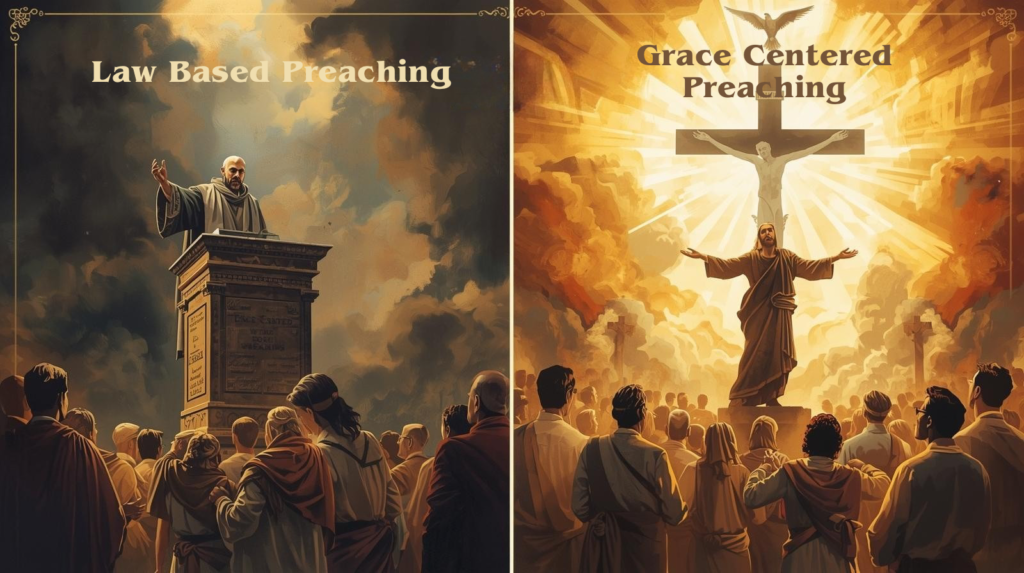
Brothers and sisters in ministry, we must confront an uncomfortable truth: much of contemporary preaching has inadvertently returned to Mount Sinai when Christ has brought us to Mount Zion. We preach “do this and live” when the gospel declares “live, and you will do this.” We exhort congregations to try harder when Scripture reveals they need to trust deeper. The result? Exhausted believers, frustrated pastors, and churches that look more like rehabilitation centers than resurrection communities.
The apostle Paul asked the Galatians a piercing question that echoes through twenty centuries into our modern sanctuaries: “Are you so foolish? After beginning by means of the Spirit, are you now trying to finish by means of the flesh?” (Galatians 3:3). This is precisely what happens when we shift from grace-centered transformation to law-based preaching methodology.
Let us begin where Scripture begins—with the foundational truth that the Old Covenant was never meant to empower obedience; it was designed to expose inability. Romans 8:3 states it clearly: “For what the law was powerless to do because it was weakened by the flesh, God did by sending his own Son in the likeness of sinful flesh to be a sin offering.”
The law was powerless. Not deficient. Not incomplete. Powerless—because fallen humanity lacks the capacity to fulfill divine requirements through human effort. This is why the entire sacrificial system pointed forward to Christ. Every failed attempt, every repeated sacrifice, every Day of Atonement that had to be repeated annually—all testified to one truth: “Man cannot.”
Paul elaborates in Romans 7:18-19: “For I know that good itself does not dwell in me, that is, in my sinful nature. For I have the desire to do what is good, but I cannot carry it out. For I do not do the good I want to do, but the evil I do not want to do—this I keep on doing.” This is the testimony of a man under law—desire without power, knowledge without transformation, conviction without change.
When we preach “do this and do that” without proclaiming the power available through Christ, we place people back under this same crushing burden. We give them a standard without a Savior, commands without enablement, expectation without empowerment.
The glory of the New Covenant is not merely that God forgives our failure to keep the law, but that He fulfills the law’s requirements in us and through us by His indwelling Spirit. This is the radical shift from external compliance to internal transformation.
Ezekiel prophesied this new reality: “I will give you a new heart and put a new spirit in you; I will remove from you your heart of stone and give you a heart of flesh. And I will put my Spirit in you and move you to follow my decrees and be careful to keep my laws” (Ezekiel 36:26-27).
Notice the active verbs—all performed by God: “I will give… I will put… I will remove… I will move you.” The verb “move” or “cause” in this passage is transformative. God doesn’t merely command obedience; He produces the desire and ability to obey. He doesn’t improve the old heart; He replaces it entirely.
This is precisely what Paul declares in Philippians 2:13: “For it is God who works in you to will and to act in order to fulfill his good purpose.” The willing itself—the desire to obey—originates from God’s internal work. The acting—the power to obey—flows from the same divine source.
Second Corinthians 3:6 draws the sharp contrast: “He has made us competent as ministers of a new covenant—not of the letter but of the Spirit; for the letter kills, but the Spirit gives life.” Law-based preaching ministers death because it presents commands without power. Grace-centered preaching ministers life because it presents Christ who IS the power.
The heart of the gospel is substitution and satisfaction. Romans 8:3-4 contains the complete redemptive story: “For what the law was powerless to do because it was weakened by the flesh, God did by sending his own Son in the likeness of sinful flesh to be a sin offering. And so he condemned sin in the flesh, in order that the righteous requirement of the law might be fully met in us, who do not live according to the flesh but according to the Spirit.”
Christ didn’t come to help us fulfill the law; He came to fulfill it Himself as our representative. He lived the life we should have lived. He died the death we should have died. He satisfied every requirement, fulfilled every jot and tittle, and then—wonder of wonders—united us to Himself so that His obedience becomes ours.
This is the scandal of grace that law-based preaching misses: we don’t obey to become righteous; we obey because we’ve been made righteous in Christ. Our obedience flows from our identity, not toward it. We live from acceptance, not for acceptance.
How then should we preach? What does grace-centered transformation look like from the pulpit?
The structure of the New Testament epistles reveals the pattern: declare who they are in Christ (indicative) before calling them to live accordingly (imperative). Romans gives eleven chapters of gospel indicatives before the “therefore” of chapter 12. Ephesians presents three chapters of “blessed be the God and Father of our Lord Jesus Christ” before “I urge you to live a life worthy of the calling.”
Grace-centered preaching roots all behavioral change in identity change. We are not sinners trying to become saints; we are saints who sometimes sin. That distinction revolutionizes how we address sin and call for holiness.
When a believer struggles with sin, they don’t need more condemnation; they need to be reminded of their true identity in Christ. “You are not an angry person trying to be patient; you are a patient person (because Christ’s patience lives in you) who sometimes loses their temper. That behavior doesn’t match who you really are.”
Law-based preaching says: “Here’s the problem, here’s what you should do, now go try harder.” Grace-centered preaching says: “Here’s the problem, here’s who Christ is, here’s what He’s done, here’s who you are in Him, now live from that reality.”
Every sermon should increase people’s vision of Christ. Colossians 1:27 reveals the secret of transformation: “Christ in you, the hope of glory.” Not Christ near you, helping you, or even empowering you from outside—but Christ IN you. Union with Christ is the engine of transformation.
When preaching on love, don’t just command “love one another.” Preach the love of Christ shed abroad in our hearts by the Holy Spirit (Romans 5:5). When preaching on forgiveness, don’t just say “you must forgive.” Preach Ephesians 4:32: “Be kind and compassionate to one another, forgiving each other, just as in Christ God forgave you.” The divine pattern always precedes the human practice.
Jesus’ metaphor in John 15 is revolutionary: “Remain in me, as I also remain in you. No branch can bear fruit by itself; it must remain in the vine. Neither can you bear fruit unless you remain in me” (John 15:4).
Notice what Jesus didn’t say. He didn’t say “try really hard to produce fruit.” He didn’t give a seven-step program for fruit production. He said “abide”—remain, stay connected, draw your life from Me.
Grace-centered preaching teaches moment-by-moment dependence. “Lord, I cannot love this difficult person, but You in me can. I yield to You.” “Holy Spirit, I don’t have patience for this trial, but Your fruit in me is patience. I depend on You right now.” This is active surrender—not passive waiting, but also not self-generated effort.
When believers sin, law-based preaching scolds the old nature. Grace-centered preaching awakens the new nature. There’s a profound difference.
Second Corinthians 5:17 declares: “Therefore, if anyone is in Christ, the new creation has come: The old has gone, the new is here!” This is present-tense reality, not future aspiration. The believer is not becoming a new creation; they ARE a new creation.
Preach to who they are, not just what they should do. “You have the mind of Christ” (1 Corinthians 2:16). “You have been given everything you need for life and godliness” (2 Peter 1:3). “His divine power has given us everything we need for a godly life through our knowledge of him who called us” (2 Peter 1:3).
When preaching against sin, appeal to the new nature: “That’s not who you are anymore. You’re dead to sin and alive to God in Christ Jesus” (Romans 6:11). This awakens the regenerated heart rather than merely condemning the flesh.
The Holy Spirit is not a distant helper who might show up if we’re spiritual enough. He indwells every believer permanently (John 14:16-17). His fruit grows in us as we walk in step with Him (Galatians 5:22-25).
Grace-centered preaching teaches believers to recognize and respond to the Spirit’s real-time ministry. “Holy Spirit, what are You saying right now?” “Spirit of God, give me Your love for this person in this moment.” “Helper, I need Your wisdom for this decision today.”
This is the “grace to help in time of need” that Hebrews 4:16 promises at the throne of grace. Grace isn’t merely judicial (God’s declaration of our righteousness); grace is also functional (God’s enabling power for daily life). We must preach both.
Law-based preaching presents prayer, Bible reading, fellowship, and other disciplines as duties we perform to earn God’s favor or prove our spirituality. Grace-centered preaching presents them as means of grace—channels through which we receive what God is freely giving.
Prayer isn’t twisting God’s arm; it’s aligning our hearts with His purposes. Scripture reading isn’t accumulating information to impress God; it’s feeding on Christ who is the Living Word. Fellowship isn’t fulfilling an attendance requirement; it’s experiencing Christ’s presence through His body.
Think of spiritual disciplines like opening curtains to let sunlight in. The sun (God’s grace) is always shining. The disciplines don’t create the light; they simply remove obstacles so we can receive what’s already freely given.
Law-based preaching produces:
Grace-centered transformation produces:
Here is the question every preacher must answer: Are your sermons leaving people focused on their performance or on Christ’s perfection? Do they walk away thinking “I need to try harder” or “I need to trust deeper”?
If your preaching primarily produces guilt, striving, and resolution to “do better next week,” you may be ministering law, not grace. If your preaching increases people’s vision of Christ, deepens their understanding of their identity in Him, and teaches them to draw on His indwelling power, you are ministering the Spirit who gives life.
Paul’s testimony should be ours: “We proclaim him, admonishing and teaching everyone with all wisdom, so that we may present everyone fully mature in Christ. To this end I strenuously contend with all the energy Christ so powerfully works in me” (Colossians 1:28-29).
Notice: Paul worked strenuously, but not in his own strength. He contended with “all the energy Christ so powerfully works in me.” This is the gospel pattern—full effort fueled by divine power, not human striving independent of God’s grace.
Psalm 127:1 must be the motto of every preacher: “Unless the Lord builds the house, the builders labor in vain.” We can preach law-based sermons that whip people into temporary behavioral modification, but unless the Lord transforms hearts, we labor in vain. We can create programs, systems, and accountability structures, but unless the Lord works from the inside out, we’re building with wood, hay, and straw.
The glory of grace-centered preaching is that we’re cooperating with what God is already doing in His people. We’re pointing them to the life of Christ that’s already within them. We’re teaching them to draw on the power that’s already been given. We’re reminding them of the identity that’s already theirs.
This is why Paul could say with such confidence: “I am confident of this, that he who began a good work in you will carry it on to completion until the day of Christ Jesus” (Philippians 1:6). The transformation isn’t ultimately dependent on our eloquence, their willpower, or the brilliance of our sermon structure. It depends on God’s faithfulness to complete what He started.
A Call to Pastoral Faithfulness
Brothers and sisters in ministry, I urge you: examine your preaching. Are you offering people the “do and live” of Mount Sinai or the “live and do” of Calvary? Are you calling them to perform or inviting them to abide? Are you increasing their burden or revealing their freedom?
The people in your pews are weary of “try harder” sermons. They’re exhausted from performance-based spirituality. They need to hear the liberating truth that Christ has done what they could never do, that His Spirit now lives in them, and that transformation happens as they abide in Him, not as they strive in themselves.
This doesn’t mean we avoid calling sin “sin” or that we lower God’s standards. Rather, it means we proclaim both the height of God’s holiness AND the sufficiency of Christ to fulfill it in and through us. We preach the demand AND the supply. We declare the goal AND the grace to reach it.
“But thanks be to God, who always leads us as captives in Christ’s triumphal procession and uses us to spread the aroma of the knowledge of him everywhere” (2 Corinthians 2:14).
May our preaching spread the aroma of Christ—the grace that transforms, the power that enables, the love that compels. Not law that condemns, but Spirit that gives life.
For His glory and honor,
Amen!
For Further Study:

Misalignment is not a “small thing” in the end-time. When a believer, a leader, or an entire church drift from God’s will, plan, and purpose, the consequences are not merely

In every generation, the people of God face a sobering choice: will we embrace the full truth of God’s Word, or settle for a watered-down version that pleases the ear

Tears Have Weight in Heaven — God said, “I have seen your tears.” Hezekiah’s weeping was not weakness. It was worship. Tears are the language of a heart that has

). I come against every adversary standing at the door of my breakthrough. Every spiritual resistance, every demonic interference, every financial blockage, and every force assigned to delay or deny

In the name of Jesus, I uproot every generational pattern of disease—whether it came through DNA, behavior, trauma, words, or demonic influence. I cancel every diagnosis and every expectation of

Many believers sincerely love God, attend church, and hear the Word often—yet when pressure comes, their mouth doesn’t release Scripture, faith, or spiritual language. Instead, what comes out is fear,