“If you declare with your mouth, ‘Jesus is Lord,’ and believe in your heart that God raised him from the dead, you will be saved.” – Romans 10:9
“Why do you call me, ‘Lord, Lord,’ and do not do what I say?” – Luke 6:46
“Not everyone who says to me, ‘Lord, Lord,’ will enter the kingdom of heaven, but only the one who does the will of my Father who is in heaven.” – Matthew 7:21
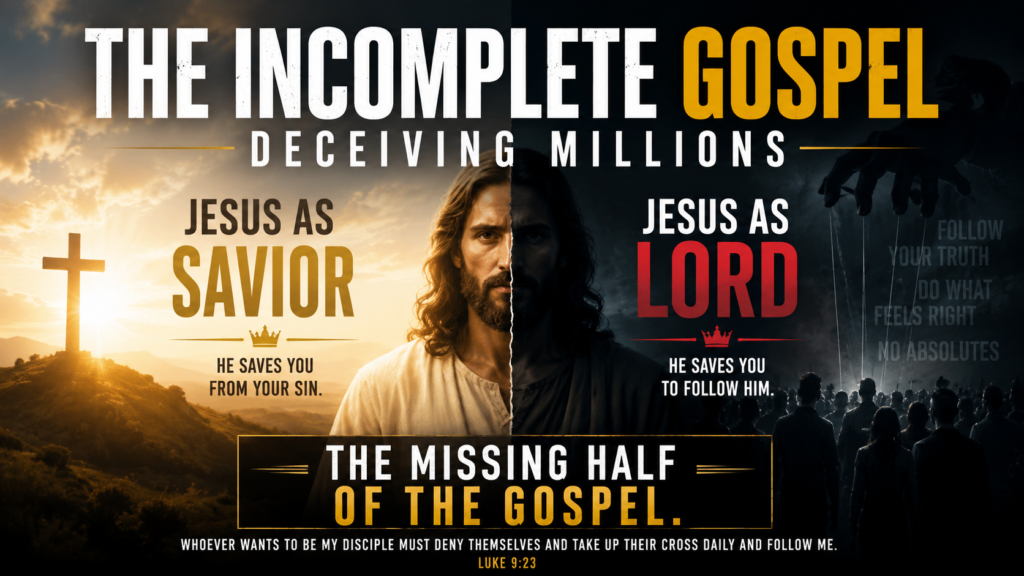
The Incomplete Gospel That’s Damning Millions
This God given truth exposes perhaps the most dangerous truncation of the Gospel in modern Christianity: millions know Jesus as Savior but have never submitted to Him as Lord. They want His benefits without His authority. They desire His salvation without His sovereignty. They embrace His forgiveness without His rulership.
This isn’t a minor theological distinction – it’s the difference between genuine salvation and religious deception. The Scripture is crystal clear: salvation comes through confessing “Jesus is LORD,” not merely acknowledging Him as Savior. Yet even ministers – those who should know better – preach a gospel that offers fire insurance without life transformation, heavenly destination without earthly submission.
The result is churches filled with people who believe they’re saved because they prayed a prayer, walked an aisle, or “accepted Jesus,” while their lives show no evidence of His lordship. They have a Savior-relationship but not a Lord-relationship, and Scripture indicates this may not be salvation at all.
The Biblical Foundation: Lordship Is Central to Salvation
Romans 10:9 – The Confession That Saves
“If you declare with your mouth, ‘Jesus is Lord,’ and believe in your heart that God raised him from the dead, you will be saved.”
Notice what’s required:
- Not “Jesus is Savior” – though He is
- Not “Jesus forgives” – though He does
- Not “Jesus loves me” – though He does
- But “Jesus is LORD” – which demands total surrender
The Greek word Kyrios (Lord) means:
- Master, owner, supreme authority
- One who has absolute rights over another
- Sovereign ruler who demands obedience
- God Himself (used in the Septuagint for Yahweh)
What this confession actually means:
- Acknowledging Jesus’ absolute authority over your life
- Surrendering your right to self-rule
- Submitting to His commands and will
- Transferring ownership of your life from yourself to Him
- Accepting His sovereignty over every area of your existence
Acts 2:36 – Peter’s Pentecost Proclamation
“Therefore let all Israel be assured of this: God has made this Jesus, whom you crucified, both Lord and Messiah.”
Peter’s emphasis:
- The first Christian sermon didn’t just announce Jesus as Savior
- It declared His lordship – His absolute authority and sovereignty
- The resurrection proved His right to rule
- The people’s response was “What shall we do?” – acknowledging His authority
The result: “Those who accepted his message were baptized” – they submitted to His lordship through baptism, a public declaration of allegiance transfer.
Philippians 2:9-11 – The Name Above All Names
“Therefore God exalted him to the highest place and gave him the name that is above every name, that at the name of Jesus every knee should bow, in heaven and on earth and under the earth, and every tongue acknowledge that Jesus Christ is Lord, to the glory of God the Father.”
The ultimate reality:
- Jesus’ lordship is universal – everyone will acknowledge it eventually
- Some acknowledge it now in salvation and worship
- Others will acknowledge it later in judgment and terror
- The question isn’t IF He’s Lord, but WHEN you’ll acknowledge it
1 Corinthians 12:3 – The Test of Genuine Faith
“Therefore I want you to know that no one who is speaking by the Spirit of God says, ‘Jesus be cursed,’ and no one can say, ‘Jesus is Lord,’ except by the Holy Spirit.”
Paul’s principle:
- True confession of Jesus’ lordship requires the Holy Spirit
- It’s not mere words but heart submission enabled by God
- This is the mark of genuine conversion
- Religious people can say the words, but true submission comes only through divine work

 Share this teaching with a friend or loved one so that they could make Jesus Christ their Lord.